
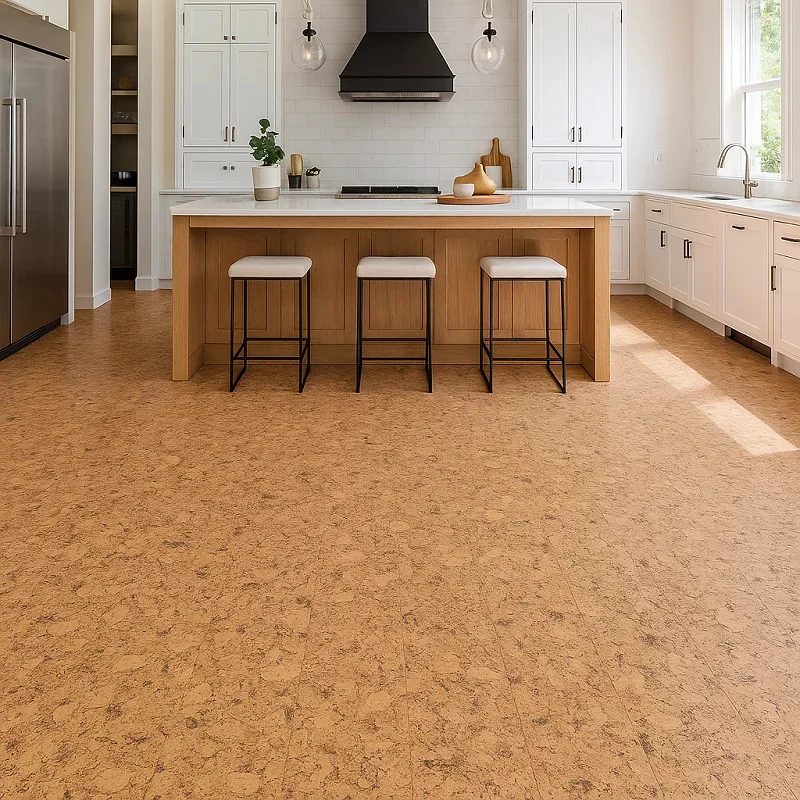
Cork flooring needs less upkeep than hardwood and a bit more attention than tile, mostly around water and direct sun. Sweep or vacuum it several times a week, damp mop it (never soak it), keep it out of unfiltered sun for hours at a stretch, and recoat the factory finish every 3 to 5 years. Do those four things and a cork floor routinely lasts 25 to 40 years. Skip them and the finish wears through in patches, the color shifts unevenly, or water works into the seams and swells the planks.
We install and refinish cork flooring across San Diego County, and most of the calls we get about a cork floor "failing" trace back to maintenance, not the material itself. This guide covers the cleaning routine that actually works, how often to reseal, how to stop UV fading near San Diego's big view windows, whether cork holds up with pets, and when a worn cork floor should be refinished instead of torn out and replaced with hardwood or laminate.
Have a cork floor that needs a look, or thinking about installing one? Request a free in-home estimate or call +1 (619) 777-4334.
Routine Cleaning, Sweeping and Damp Mopping
Cork's cell structure is naturally full of suberin, a waxy substance that makes the material resist mold, mildew, and dust mites better than most flooring. That natural resistance protects the cork itself, but it is the surface finish, either a factory-applied polyurethane or a site-applied acrylic wax, that takes the actual wear from foot traffic. Routine cleaning is really about protecting that finish.
Sweep, dust mop, or vacuum 2 to 3 times a week in busy rooms, and daily in an entryway or kitchen. If you vacuum, turn off the beater bar or use the hard-floor setting, since a spinning brush roll can scuff a wax finish over time. Once a week, damp mop with a pH-neutral cleaner made for wood or cork floors, using a microfiber mop wrung out until it is barely damp. Let the floor air dry rather than wiping it fully dry, and never use a steam mop, the heat and forced moisture can work into the seams and soften the adhesive on a glue-down floor or swell a floating floor's core.
Deep Cleaning and Removing Stains
Beyond the weekly damp mop, cork occasionally needs spot treatment for specific messes. Match the cleaning method to the stain rather than reaching for whatever is under the sink, since the wrong product can dull or discolor the finish faster than normal foot traffic ever would.
- Food, grease, and dirt: warm water with a small amount of mild dish soap, applied with a barely-damp cloth, then wiped with a clean damp cloth to remove soap residue.
- Pet accidents: blot up the liquid immediately, clean the area with a pH-neutral cleaner, and dry it fully. Do not let urine sit on cork, its acidity can etch a wax finish and discolor the cork underneath.
- Scuff marks: a pencil eraser or a melamine sponge (like a Magic Eraser), rubbed gently rather than scrubbed.
- Ink, dye, or crayon: a small amount of rubbing alcohol on a cloth, tested first in a closet or under an appliance since alcohol can strip a wax finish in that exact spot.
- Dried gum or wax: harden it with an ice cube in a plastic bag, then lift it gently with a plastic scraper, never metal.
Whatever cleaner you use, check the label against your finish type first. Acidic cleaners, including undiluted vinegar, are fine on a fully cured urethane finish but will strip an acrylic wax finish over repeated use, since wax has no acid resistance built in the way a urethane coating does.
How Often Should You Reseal a Cork Floor?
A cork floor's finish, not the cork itself, is what fails first, and recoating it before it wears through is the single most effective thing you can do for a long-lasting floor. How often depends on the finish type and how much traffic the room gets.
| Finish Type | Low-Traffic Room | High-Traffic Room |
|---|---|---|
| Factory UV-cured polyurethane | Every 4 to 5 years | Every 2 to 3 years |
| Site-applied acrylic wax | Every 2 years | Every 1 to 1.5 years |
A simple water-bead test tells you when it is time. Splash a few drops of water on the floor in a well-worn path, like in front of the sink or the sofa. If the water beads up and sits on the surface for a minute or more, the finish is still doing its job. If it soaks in or darkens the cork within a few seconds, the finish is worn through in that spot and it is time to recoat the whole room, not just the worn patch, to keep the sheen even.
Recoating (also called maintenance coating) means applying a fresh layer of finish over the existing one after a light cleaning and light scuff-sanding, without stripping the floor down to bare cork. A professional recoat runs about $1.50 to $3.00 per square foot depending on the amount of surface prep needed. DIY recoat kits run roughly $50 to $90 per gallon and cover about 400 to 600 square feet with a single coat, which works for a straightforward wax or water-based urethane touch-up.
Preventing UV Fading and Sun Damage
Cork is a natural material, and like hardwood, continuous UV exposure changes its color over time, usually ambering or darkening rather than bleaching out. Very light or blonde-toned cork can also show uneven blotching where a rug, runner, or piece of furniture has blocked the sun in one spot while the surrounding floor kept darkening. In a room with large, unfiltered south- or west-facing windows, a visible color shift can show up within 6 to 12 months, faster in rooms that get direct afternoon sun for several hours a day.
This matters most in San Diego's sun-heavy coastal homes. Big view windows are common in the houses we work on in La Jolla and Encinitas, and those rooms get exactly the kind of long, direct light exposure that ambers cork fastest. A few habits prevent most of the damage:
- UV-blocking window film: blocks roughly 99 percent of UV rays without changing how much visible light comes through, the single most effective fix for a sun-exposed room.
- Close blinds or curtains during peak afternoon sun, typically 1 to 4 p.m., in rooms with west-facing glass.
- Rotate rugs and furniture every 3 to 4 months so no single area of floor gets permanently shaded while the rest darkens around it.
- Choose a finish with UV inhibitors added if you are installing new cork; most factory-finished prefinished cork already includes this, but it is worth confirming with your installer.
Is Cork Flooring Scratch Resistant with Pets?
Reasonably, yes, better than most people expect. Cork's cell structure holds up to 40 million tiny air-filled pockets per cubic centimeter, which gives the material a cushioned, slightly springy quality. That cellular give means light scratches and small dents from dog nails or a dropped chair leg often shrink back over the following hours or days as the compressed cells slowly re-expand, something hardwood and laminate cannot do once dented.
That said, cork is genuinely soft. On the Janka hardness scale, cork measures around 2.5 to 4, compared to roughly 1,290 for red oak, so while it resists surface scratching from normal foot traffic well, concentrated point pressure from an untrimmed claw, a stiletto heel, or an unpadded furniture leg can still puncture the finish and dent the cork underneath. For a full comparison of how cork stacks up against other pet-friendly options, our best flooring for homes with pets guide breaks down cork alongside hardwood, LVP, and laminate.
A few habits keep cork looking good in a house with pets: trim nails on a regular schedule so claws stay blunt, use felt or rubber pads under all furniture legs, and place a washable rug or runner along the paths pets use most, like from the back door to the water bowl.
Refinishing vs Replacing Cork Flooring
Cork planks and tiles are thin compared to solid hardwood, typically 1/8 inch (3mm) to 3/16 inch (5mm) of visible cork on a floating floor over an HDF core, or 3/16 to 5/16 inch total on a glued-down solid cork tile. Because the wear layer is thin, a cork floor can usually be lightly sanded and refinished once, sometimes twice, over its lifetime, compared to the 4 to 6 sandings a solid hardwood floor can typically handle. Removing even 1/32 inch of material during a sand takes a meaningful bite out of cork's total thickness, so this is not a job to repeat often.
Refinishing makes sense when the cork itself is intact and the damage is cosmetic: dulling, minor scratches, uneven fading, or a finish that is worn through in spots but the planks are not punctured to the backing. A light sand and recoat runs about $3 to $6 per square foot depending on the room size and how much sanding the floor needs.
Replacement is the better call when the cork is punctured through to the underlayment, boards have delaminated or buckled at the seams, or a flood left the planks swollen and out of shape. New cork flooring installed runs roughly $6 to $12 per square foot, in the same range as our cork flooring installation pricing. For comparison, our hardwood refinishing timeline guide covers why hardwood tolerates repeated sanding so much better, thickness is the whole reason.
Common Cork Maintenance Mistakes to Avoid
- Flooding the floor with a wet mop. Cork only needs a barely-damp microfiber mop; excess water finds its way into the seams.
- Using vinegar or ammonia on a wax-finished floor. Acidic cleaners strip acrylic wax quickly, even though the same cleaner is fine on a urethane finish.
- Waiting until the finish is gone to reseal. Recoating on schedule protects the cork; recoating after the finish has already worn through in patches means an uneven result and sometimes visible color difference.
- Skipping felt pads under furniture. Cork's softness means unpadded furniture legs leave permanent indentations faster than they would on hardwood.
- Leaving blinds open all day in a high-sun room. Consistent, unblocked UV exposure is the fastest way to get uneven ambering within the first year.
- Using a steam mop. The heat and forced moisture soften finish and adhesive, similar to the damage it causes on LVP and laminate floors.
Frequently Asked Questions
How Often Should You Clean Cork Flooring?
Sweep or vacuum (hard-floor setting, no beater bar) 2 to 3 times a week in busy rooms, and damp mop with a pH-neutral cleaner once a week. Wipe up spills within a few minutes rather than letting them sit.
Can You Use Vinegar to Clean Cork Floors?
Only if the floor has a urethane finish. On acrylic wax-finished cork, vinegar's acid breaks down the wax layer and dulls the finish faster. Check which finish your floor has before using an acidic cleaner, or stick with a pH-neutral cleaner made for cork or wood floors.
How Often Does Cork Flooring Need to Be Resealed?
Every 3 to 5 years for a factory polyurethane finish in a low-traffic room, every 2 to 3 years in high-traffic areas, and every 1 to 2 years for a site-applied acrylic wax finish. A quick water-bead test tells you: if drops absorb instead of beading up, it is time to recoat.
Does Cork Flooring Fade in Sunlight?
Yes. Cork is a natural material and continuous UV exposure ambers or darkens it unevenly over months, especially in rooms with large south- or west-facing windows common in San Diego homes. UV-blocking window film, closed blinds during peak sun, and rotating rugs and furniture every few months prevent visible shadow lines and fading.
Is Cork Flooring Good for Homes with Dogs and Cats?
Yes, with reasonable care. Cork's cellular structure gives it some cushioning that resists dents and lets light scratches shrink back over time, which is better than what happens on hardwood or laminate. Keep pet nails trimmed and use a washable rug in main traffic paths, since untrimmed claws can still puncture the finish.
Can a Cork Floor Be Refinished Instead of Replaced?
Usually, if the cork itself is intact. A light sand and recoat, or a simple recoat with no sanding, fixes dulling, minor scratches, and uneven fading for $3 to $6 per square foot. Replacement is the better call if the cork is punctured through to the backing, delaminated, or swelled from standing water.
What Is the Best Way to Clean Cork Floors Without Damaging the Finish?
Sweep or vacuum first to remove grit, then damp mop with a barely-damp microfiber mop and a pH-neutral cleaner. Never use a steam mop, wax over a urethane finish, ammonia, bleach, or abrasive scrub pads, all of which strip or scratch the finish.
How Long Does a Well-Maintained Cork Floor Last?
25 to 40 years with routine cleaning and reseals kept on schedule. Most cork floors that fail early do so from water damage or a finish that was never recoated, not from the cork itself wearing out.