Cork is the best flooring for a craft room or home office because it cushions your feet and knees during long projects, absorbs sound so video calls stay quiet, and resists dents from dropped tools better than most people expect. Laminate is the best budget pick, and vinyl plank is the safer choice if your craft work involves paint, resin, or dye that could stain a natural material. We install all three across San Diego: see cork flooring in San Diego, laminate flooring in San Diego, and luxury vinyl plank in San Diego for product options and pricing.
A craft room or home office is not like any other room in the house. You are standing or kneeling for hours at a time, you need enough quiet for calls and focus work, and you are working around glue, paint, thread, resin, or sewing pins that end up on the floor no matter how careful you are. Finding the best flooring for craft room use, or the right flooring for a home office, means weighing comfort, sound, and spill resistance differently than you would for a living room or bedroom.
- Best overall: Cork (cushioned, quiet, naturally renewable, sealed finish resists spills)
- Best budget: Laminate (12mm options run $3 to $7 per sqft installed, hard enough for rolling chairs)
- Best for heavy spill risk: Vinyl plank (100% waterproof core, shrugs off paint, resin, and dye)
- Avoid: Carpet (traps thread, glitter, and pins; hard to vacuum out of loop fibers)
- Typical cost for a 120 to 150 sqft room: $720 to $1,800 installed depending on material
Ready to compare samples in your space? Request a free in-home estimate or call +1 (619) 777-4334.
What a Craft Room or Home Office Needs From Flooring
Before picking a material, it helps to name what actually matters in this room. Four things separate a good choice from a bad one.
Comfort for Standing and Kneeling
Quilting, painting, model building, and desk work all involve long stretches of standing or kneeling on the same few square feet. A hard, cold surface like tile or polished concrete gets uncomfortable within an hour. A floor with some natural give reduces fatigue in your feet, knees, and lower back.
Sound Dampening
If your home office doubles as a call room, or your craft room sits above or next to a bedroom, sound matters. Hard surfaces bounce noise around and transmit footfall to the room below. A material with natural sound absorption keeps both airborne noise (voices, music) and impact noise (rolling chairs, dropped tools) from carrying through the house.
Resistance to Drops and Spills
Dropped scissors, spilled paint, hot glue, and resin are a normal Tuesday in a craft room. The floor needs a sealed, non-porous surface that will not stain permanently or dent from a dropped tool.
Easy Cleanup
Thread, glitter, sawdust, and paper scraps end up on the floor constantly. A smooth surface that sweeps and vacuums easily beats anything with deep texture or loop fibers that traps small debris.
Cork Flooring for Craft Rooms and Home Offices
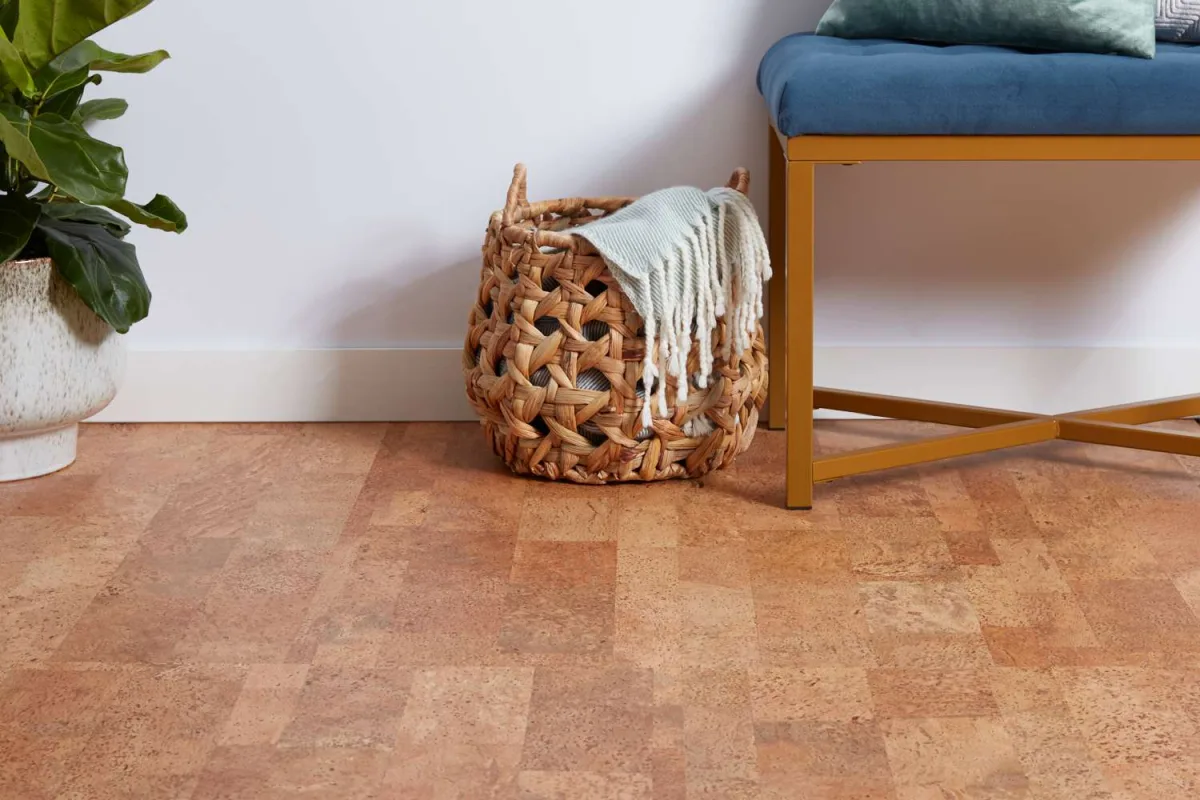
Cork flooring is our top recommendation for this specific use case, and it is not a close call. Cork is harvested from the bark of the cork oak tree without cutting down the tree, which regrows its bark over roughly 9 years, making it one of the more renewable flooring materials available (certification standards are set by the Forest Stewardship Council). Here is why it fits a craft room or office so well:
- Natural cushioning - cork's cellular structure is roughly 50% air, which absorbs impact and reduces fatigue during long standing or kneeling sessions
- Sound absorption - cork can reduce impact noise transmission by up to 20 decibels compared to hard-surface flooring, which matters for calls and shared walls
- Sealed finish resists spills - a factory-sealed polyurethane finish on modern cork keeps paint, glue, and dye from soaking into the material, as long as spills are wiped up within a reasonable time
- Naturally quiet underfoot - no clicking or hollow sound from rolling chairs or dropped tools the way some laminate can produce
- Warmer than tile or vinyl - cork retains warmth better than hard-surface flooring, which matters if you are barefoot or in socks for hours
Cork installed runs $6 to $12 per square foot depending on plank quality and finish. It is a mid-range investment that costs more than laminate but less than most engineered hardwood, and it is the only material on this list built specifically around comfort and sound.
Laminate as a Budget Alternative
Laminate flooring is the practical budget pick if cork is outside your price range. A 12mm AC4 or AC5 rated laminate is hard enough to handle a rolling office chair without denting, and it holds up well to foot traffic and dropped tools.
Laminate installed runs $3 to $7 per square foot, roughly half the cost of cork. The tradeoffs are less cushioning underfoot (it sits on a thin foam underlayment rather than cork's natural give) and less sound absorption. Standard laminate is also not waterproof, so spilled paint or dye needs to be wiped up quickly to avoid seeping into the seams.
A chair mat under a rolling office chair extends the life of any laminate floor and prevents surface scuffing from repeated wheel contact in the same spot.
Vinyl Plank for Heavy Spill Risk
If your craft work involves resin casting, dye, ink, or oil paint, luxury vinyl plank is the safer choice over cork or laminate. LVP has a 100% waterproof rigid core, so spilled resin, paint, or dye sits on the surface instead of soaking in, giving you time to clean it up without permanent staining.
LVP installed runs $4 to $9 per square foot depending on wear layer thickness. Choose a rigid-core SPC or WPC product with at least a 12 mil wear layer for a craft room, since dropped tools and rolling chair wheels see more repeated contact in one spot than in a typical living room.
The downside compared to cork is comfort. LVP has some give from its core construction, but nowhere near the cushioning of cork, and it does not absorb sound the same way. For a hybrid approach, a cushioned anti-fatigue mat at the main work station on top of LVP gives you both the spill protection and the comfort.
Cost Comparison for a 120 to 150 Sqft Room
Most home offices and craft rooms fall in the 120 to 150 square foot range. Here is what each material costs fully installed at that size:
| Flooring Type | Cost per Sqft Installed | 120 Sqft Total | 150 Sqft Total |
|---|---|---|---|
| Laminate (12mm AC4/AC5) | $3.00 - $7.00 | $360 - $840 | $450 - $1,050 |
| Vinyl plank (rigid-core LVP) | $4.00 - $9.00 | $480 - $1,080 | $600 - $1,350 |
| Cork (sealed, click-lock or glue-down) | $6.00 - $12.00 | $720 - $1,440 | $900 - $1,800 |
A small room like this is also one of the more affordable projects we quote, since even the premium cork option stays under $2,000 installed at this size. Most craft room and home office projects take a single day from start to finish.
What Is the Best Flooring for a Home Office
Cork is the best flooring for a home office for most people, because it cushions long hours at a desk, absorbs sound during video calls, and stays warm underfoot. If your office also handles paint, resin, or other craft materials, vinyl plank is the more spill-resistant choice. Laminate is the best option when budget is the deciding factor.
Frequently Asked Questions
What Is the Best Flooring for a Home Office?
Cork is generally the best flooring for a home office because it cushions long hours of sitting and standing, absorbs sound for calls, and stays warm underfoot. Vinyl plank is a strong second choice if the office also sees spills or heavy chair traffic, and laminate is the most budget-friendly option.
Is Cork Flooring Good for a Craft Room?
Yes. Cork's natural cushioning reduces fatigue during long standing or kneeling projects, and its sound-absorbing structure keeps noise from carrying through the house. A factory-sealed finish protects against typical craft room spills like paint, glue, and dye as long as messes are wiped up promptly.
Does Cork Flooring Soundproof a Room?
Cork does not fully soundproof a room, but it noticeably reduces sound transmission compared to hard-surface flooring like tile or laminate. Cork can cut impact noise transmission by up to 20 decibels, which is enough to make a real difference for video calls or a craft room next to a bedroom.
What Flooring Is Best for a Rolling Desk Chair?
A 12mm AC4 or AC5 rated laminate or a rigid-core LVP with at least a 12 mil wear layer both hold up well to rolling office chairs. Cork can handle chair traffic too, but a chair mat is recommended under the wheels to prevent surface wear over years of repeated use in the same spot.
Can You Put Vinyl Flooring in a Craft Room?
Yes, and it is often the safest choice if your craft work involves resin, dye, ink, or oil-based paint. Rigid-core vinyl plank is 100% waterproof, so these materials sit on the surface instead of soaking in, giving you time to clean spills before they cause permanent damage.
How Much Does Cork Flooring Cost Installed?
Cork flooring costs $6 to $12 per square foot installed, depending on plank quality and finish. For a typical 120 to 150 square foot craft room or home office, that works out to roughly $720 to $1,800 total, including labor.
Is Cork Flooring Durable Enough for Daily Use?
Yes, with a quality factory-sealed finish. Cork resists dents better than most people expect because its cellular structure compresses and rebounds rather than staying permanently marked. It is not as scratch-resistant as porcelain tile or rigid-core vinyl, so avoid dragging heavy furniture across it without floor protectors.
What Flooring Resists Paint and Glue Spills Best?
Rigid-core vinyl plank resists paint and glue spills best because its surface is 100% waterproof and non-porous. Sealed cork is a close second as long as spills are cleaned up within a reasonable time. Standard laminate is the most vulnerable, since paint and glue can seep into the seams if left too long.
Should I Avoid Carpet in a Craft Room?
Yes, in most cases. Carpet fibers trap thread, glitter, sawdust, and pins, all of which are difficult to fully remove even with regular vacuuming. A smooth, sealed hard surface like cork, laminate, or vinyl is far easier to keep clean in a room where small debris is constant.